Colgate Football in the Armed Forces


Colgate has a rich history of its students going on to serve their country, and the football team is no different. The following list is currently under construction (and in no particular order yet), but will eventually list every Colgate Football player who has served their country in the armed forces. If you have any info to correct, or want to contact me, send an email to colgatefootball@gmail.com...
Jack Clifford
- Colgate football – 1942
- Played with Walter McQuade for 9 years, starting in grade school in Columbus, Ohio up until 1942 when they played together at Colgate their freshman year
- His mother died mid-season in 1942 and Andy Kerr signed papers to become his legal guardian. A newspaper picked up on the story and said that Kerr had ‘adopted’ Clifford. Kerr kidded Clifford about it and started calling him ‘my boy’ to get a laugh out of him and help him recover from his mother’s passing
- Clifford and McQuade both tried out for the Marines and Navy, but when one of them did not pass the tests the other backed out. They each passed the Army tests and went in together.
- Inducted into the Army at Fort Harrison, Indiana in 1943
- Training at Camp Wolters, Texas in 1943 where he would receive the rank of Sargeant
- Camp Wolters basketball team - 1943
- Both Clifford and McQuade tried for air cadet appointments but McQuade passed and Clifford did not. McQuade again tried to back out so they could continue to serve together, but the Army did not listen.
- Clifford served in France in 1944
- Killed in action on August 24, 1944 in France
- Walter McQuade was home in Columbus, Ohio waiting for an assignment and was visiting the Clifford house when they received the news that Jack had been killed.
- “I can’t tell you what I’d have given to see that boy come back alive and well. And I wouldn’t have cared if he never played football again.” – Andy Kerr
Walter ‘Bruff’ McQuade
- Colgate football – 1942, 1946
- Played with Jack Clifford for 9 years, starting in grade school in Columbus, Ohio up until 1942 when they played together at Colgate their freshman year
- Clifford and McQuade both tried out for the Marines and Navy, but when one of them did not pass the tests the other backed out. They each passed the Army tests and went in together.
- Inducted into the Army at Fort Harrison, Indiana in 1943
- Corporal in the US Army in World War II
- Was home in Columbus, Ohio waiting for an assignment and was visiting the Clifford house when they received the news that Jack had been killed.
- Physical training instructor in the Army Air Forces at Herington Air Field, Kansas in 1945
Robinson Billings
- Colgate football – 1934, 1935
- Colgate hockey – 1934, 1935, 1936 (2x captain)
- Enlisted in the Army Air Corps in 1939
- Received training at Parks Air College in St. Louis, Randolph and Kelly Fields in Texas, and Aberdeen Proving Ground in Maryland
- Stationed in Great Falls, Montana where he ferried airplanes to Alaska and Russia
- Transferred to the Pacific to fly the B-29 Superfortress
- Lieutenant Colonel with the 468th Bombardment Group based in India and China
- Tillman Durdin wrote a piece in the New York Times about flying on a bombing run with Billings that targeted Japanese bases in Central China in 1944
- Killed in action on January 11, 1945
- He was co-pilot on a bombing run from India to the Malay Peninsula near Singapore when his plane took fire from about 20 Japanese fighter planes. The attacks disabled the guns and damaged 2 of the 4 engines on the “Postville Express”. A shot through the nose of the plane hit Billings in the left thigh. (“Colonel, are you all right?” Billings nodded yes and said with a snicker, “Hope I don’t lose that leg, it’s a damn good leg.”) The fire in the engines was quickly weakening the wings and the crew prepared to bail out. (“Check your parachutes, they should include your jungle survival pack, and make sure you have your Webb belt around your waist. Keep an eye out for one another, so you have an idea where others are touching down. Once we hit the jungle floor, it will be impossible to see each other, so we need to get our bearings before hand. Don’t go shouting for one another, because we have no way of knowing if the Japs will be waiting. We’ll push east, deeper into the jungle, and hope for a rendezvous. This may be the last time we see each other. I don’t know what to say. I haven’t rehearsed anything. Good luck. May God be with us!”) Before they could jump, the wing collapsed and the plane went into a dive. Sgt Kundrat, who was working on Billings leg, and Billings did not survive the crash. Sgt Spratt survived the crash but died soon after from his injuries. The other members of the crew survived and hid in the jungle, but Captain Hansman was captured by the Japanese and executed in February 1945. Four others were captured and spent the rest of the war as POW’s. The three remaining crew members eluded capture with the help of guerillas.

Michael Joseph Hayes
- Colgate football – 1916
- Colgate track – 1916
- Colgate hockey – 1917, 1918 (captain)
- Delta Upsilon
- Skull and Scroll
- Noted amateur boxer
- Won commission at first officers training school in Plattsburgh, New York
- 306th Infantry, Company F, Camp Upton
- Camp Upton Hockey team coach
- Camp Upton football team (played in Polo Grounds)
- 1918 Millrose Games Half Mile in Full Equipment – 1st Place
- 1918 Army Citation – First Lieutenant Michael J. Hayes, 306th infantry, while accompanying his company commander on the night of Aug 11-12, 1918, during a relief, assisted very materially his company commander during heavy shelling of high explosives by indicating to individual men where each could best seek shelter, to the utter disregard of his own personal safety. On Aug 14, 1918, with great courage and coolness, he led a patrol of three men and himself to the rescue of his company commander, who was lying approximately twenty yards in front of a German machine gun post of greatly superior numbers, and with great courage and dash attacked this machine gun post, inflicting several casualties with hand grenades and rifle fire, and drew heavy fire from machine guns and somehow managed to return with his patrol to safety.
- The company commander he tried to rescue, Robert Porter Patterson, managed to escape later that night and went on to become Secretary of War from 1945-1947.
- Killed in action on October 14, 1918
- He was posthumously awarded the Distinguished Service Cross, the second highest military award that can be given to a member of the Army.
- Excerpt from his Distinguished Service Cross citiation: On 14 October First Lieutenant Hayes led his platoon forward into the attack with energy and courage, in the face of heavy artillery and machine-gun fire. In the face of direct fire from enemy machine-guns upon his platoon, disregarding his own personal safety, he went forward to reconnoiter and find cover for his men from which to continue the attack. In the performance of his courageous enterprise he was killed by machine gun fire.
- Buried in Section 3, Grave 4250-NH of Arlington National Cemetery
Robinson Billings

Don Wemple
- Colgate football – 1936, 1937, 1938 (captain)
- 1939 East-West Shrine Game
- 1941 - Brooklyn Dodgers (NFL)
- 1942 - Aviation cadet at Maxwell Field in Montgomery, Alabama
- In July 1942 he was transferred from Arcadia Field, Florida to Cochrane Field in Macon, Georgia after completing about 70 hours of solo flight training.
- Second Lieutenant in the Army Air Corps
- He was killed in June 1943 when his transport was damaged by enemy fire traveling from India to China. He tried to fly it on one engine but crashed near his intended landing field in China. His Colgate football teammate and co-captain from 1938, John Lucy, was stationed at the field and was one of the first ones to reach the wreckage. Wemple was badly hurt and the rescuers were not able to free him from the plane immediately. After speaking with a chaplain, Wemple spoke his last words. He was asked how he was feeling and replied “I’m all right now, coach, put me back in the game.”
Michael Joseph Hayes

Anthony ‘Tally’ LaBella
- Colgate football – did not letter
- Member of the football team for two years, graduated in 1937 and enlisted in the Navy Air Force
- Joined the Royal Canadian Air Force sometime after that and had the rank of Pilot Officer (about 15,000 Americans joined the Canadian forces prior to the US entering World War II, with 9,000 of them going to the RCAF. Great Britain and Canada recruited pilots after many were lost in the Battle of Britain in 1940)
- Killed in a plane crash in Armstrong, Ontario, Canada on August 12, 1942
Don Wemple (Right, with John Lucy)
Oscar Carl ‘Oc’ Anderson
- Colgate football – 1914, 1915, 1916, 1919
- First Team All-American – 1916, 1917 (only military players selected by Walter Camp in 1917)
- 1917 Camp Dix football (captain), and track
- Served two years in France in World War I – 311th Infantry
- Buffalo All-Americans (APFA, later the NFL) 1920-1922
- Suffered from emphysema due to a long history of smoking and the side effects of poisonous gas inhaled during his time on the line in France. Anderson referred to the condition as “hard to spell and expensive as hell”
Joseph Brooks
- Colgate football – 1912, 1913, 1914
- Colgate track – 1912
- Williams College football – 1909, 1910
- Colgate football assistant coach – 1915
- Williams College head coach – 1916, 1919-1920
- Columbia College assistant coach – 1921
- His brother, Belvidere Brooks, was killed in action in France in World War I. His other brother, Bruce, also served in France in the war.
- First Lieutenant and Captain in the Army in World War I
- 150th Machine Gun Battalion, 42nd Division
- Served in France with General Pershing’s expedition
- Fought in the Battle of Chateau-Thierry, the Battle of Saint-Mihiel, and in the Meuse-Argonne Offensive
- In charge of a raiding party into No Man’s Land in 1918. Returned to headquarters with several German prisoners, including one he carried underneath his arm.
- “It all seemed to be a dream and I can’t realize yet that I have killed men with neither feeling nor compunction. Then it was kill or be killed and a Hun was born to be killed anyway so it really doesn’t matter.” – Joe Brooks letter to Professor Whitnall, 1918
- Married Alicia Patterson, the daughter of a Chicago publisher, in 1931. The engagement was a secret until Brooks crashed Patterson’s plane while flying from Chicago to New York. Motor failure forced him down near South Bend, Indiana and a gust of wind blew him into a tree.

Larry Cabrelli
- Colgate football – 1938, 1939, 1940
- Philadelphia Eagles – 1941-1942 (team MVP), 1944-1947 (captain)
- Philadelphia/Pittsburgh ‘Steagles’ – 1943
- Joined the military but was classified as 4F for a bad knee
- Philadelphia Eagles assistant coach – 1948-1950, NFL Champions in 1948 and 1949
Joe Brooks
Joseph Duckworth
- Colgate football – 1946
- Harvard University – 1942 Air Corps ground school course
- Captain in the Army Air Transport Command in World War II
- Army All-Star football team – 1942 (defeated the Detroit Lions 12-0)
- Air Transport Command Rockets football team – 1945
- Washington Redskins – 1947
Andrew Kerr Jr.
- Colgate football – did not letter
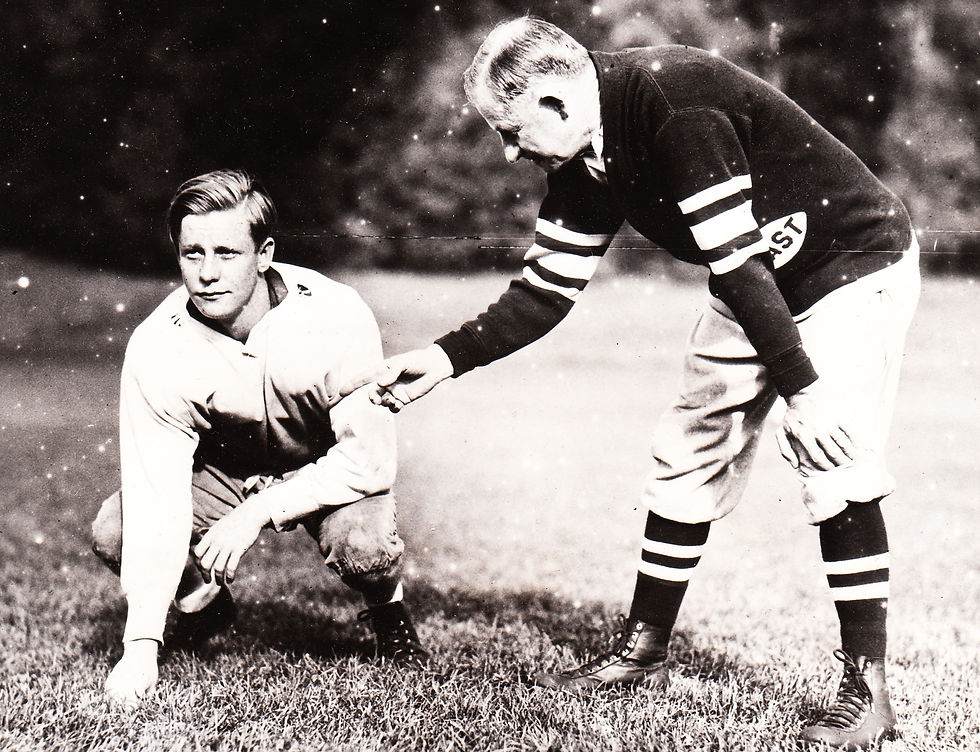
- Andy Kerr’s son
- Colgate track
- Graduated in 1937
- Harvard Medical School graduate – 1941
- Captain with the Medical Corps of the Army in World War II – 39th Infantry
- While he was attached to a general hospital in England in 1945 he coached the 111th Aces football team. They were unbeaten, untied, and unscoredupon… until the final 4 seconds of the season when they gave up a touchdown.
- Awarded the Bronze Star and two Presidential Unit Citations
- Awarded the Silver Star in 1945 – “Captain Andrew Kerr, Jr., Medical Corps United States Army, who distinguished himself by gallantry in action against the enemy on the 17th of April, 1945 in the vicinity of Aschersleben, Germany. When a motorized patrol encountered severe small arms fire and suffered numerous casualties, Capt. Kerr answered the call for litter bearers by leading a group of aid men forward. Disregarding personal safety, he moved about the fire-swept area, administering aid to the wounded, moving them to sheltered positions and supervising their evacuation. His courageous actions in defiance of danger, his aggressiveness and his devotion to duty were instrumental in saving many lives and reflect the highest traditions of the Armed Forces.”
William ‘Bill’ Kerr
- Colgate football – 1938
- Andy Kerr’s son
- Harvard Law School graduate – 1943
- Joined the FBI after graduating and later resigned to join the Navy as a Naval Intelligence officer
- Lieutenant (junior grade) during World War II
- Was onboard the USS Princeton when it was sunk in the Battle of Leyte Gulf
- Rescued by a destroyer after spending several hours in the water and was returned to Pearl Harbor
Andy Kerr Jr. and Andy Kerr
Dick East
- Colgate football – did not letter
- Freshman football team – 1939
- Amateur boxer at Colgate in 1941 (155 lbs)
- Lieutenant in the Army in World War II
- November 1942 – transferred from the Army Air Corps base in Jacksonville, Florida to foreign duty
- Fighter pilot with the 8th Army Air Force, 4th Fighter Squadron, 52nd Fighter Group
- Killed in action when his P-40 was shot down over Tunisia on April 4, 1943
- Awarded the Purple Heart and Air Medal
- Buried in the North Africa American Cemetery & Memorial in Tunis, Tunisia
- Had his dog, Duckworth, with him in Tunisia. When he was killed his parents sent a letter to General Eisenhower requesting to have the dog returned. Eisenhower made the arrangements, but when he heard how upset East’s squad was at losing Duckworth he decided the dog would stay. East’s parents did not know the dog meant so much to the men so they were okay with him staying. Lieutenant Harold Taff, East’s best friend, kept the dog while the squad was overseas. He gave the dog back to East’s parents when he returned to the United States. They reported that he slept next to East’s bed every night.
John ‘Jack’ Scott
- Colgate football – 1939, 1940, 1941
- Amateur boxer at Colgate in 1941 (heavyweight)
- Private in the Army in World War II
- 1942 – at Buckley Field in Denver, Colorado training to be an armorer in the Army Air Corps Maintenance Division
- 1942 – training at Berkeley Field in California
- Tail gunner in the Army Air Force in a B-17
- Listed as ‘Missing in Action’ in early 1944 after his plane went down. Some members of his crew were located as German prisoners of war, but Scott was never found.

John 'Jack' Scott
Andy Rooney
- Colgate football – did not letter
- Freshman football team – 1939
- Drafted into the Army in 1941
- Began writing for the Stars and Stripes in 1942
- Flew with the 8th Air Force in Germany in 1943
- One of the first American journalists to visit Nazi concentration camps near the end of World War II
- Awarded the Bronze Star and Air Medal
- CBS 60 Minutes – 1978-2011

From Andy Rooney's Book My War
Dan Binneweg
- Colgate football – did not letter
- Freshman football team – 1939
- Injured his shoulder in practice in 1939
- Left Colgate after his junior year to join the Army Air Corps
- 2nd Lieutenant in the Army in World War II
- Was training at Randolph Field, Texas in 1942
- Crashed a BT-9 training plane on February 6, 1942 at Randolph Field
- 12th Air Force, 33rd Fighter Group, 60th Fighter Squadron
- On November 27, 1942, he was part of 69 men and 6 officers in his squadron who moved to Oujda, Morocco on the border of Algeria
- Killed in action on December 23, 1942 over Algeria
- One week before his death he wrote a letter to Bill Reid, director of athletics at Colgate: “Dear Bill, I hope everything is going fine at Colgate. I sure do miss it. I’ve got a bet on the Syracuse game with a fellow in my squadron from Syracuse, and we haven’t even gotten the score yet. What a life! I’m over in North Africa flying. We’ve had a little action and things are really going swell. I expect we’ll have these Germans beaten pretty soon. I want to be on your list so I’ll be getting those new bulletins when they come out. Even if you have some old ones, I’d sure appreciate them. The last one I received was last summer when I was at Bolling Field. Those bulletins would really mean a lot to me, especially over here. We’ve been moving all over North Africa, sleeping in old barns, shacks, pup-tents, in the mud and rain and half freezing to death, but we’re getting there. We just need news from home to keep us pepped up. Right now I’m waiting on a truck to get to some hot springs where I can get a bath. I haven’t even had my clothes off for a week - - it’s been so cold at night. Our baggage is far behind us and such a thing as clean clothes in our outfit is unknown. However, we have a lot of fun talking over our ‘flights’ and college days, etc. Give my regards to Andy, Rockafellow, Jack Rourke and the others who might remember me. I hope I’ll be able to drop in at Colgate when I get home and say ‘hello’ to my friends. Best regards and best of luck to Colgate in all sports. I’m rooting from ‘over here’. Sincerely, Dan Binneweg”
- He was interred in the Long Island Cemetery in 1949
Hans Guenther
- Colgate football – 1939, 1940, 1941 (captain)
- Licensed pilot prior to joining the Marines
- In Quantico, VA for training in 1942
- First Lieutenant who served for 5 months on Guadalcanal
- Injured his knee in a Marine rest camp football game. Due to the injury and a case of malaria, he spent part of 1943 in a hospital at the Brooklyn Navy Yard.
- Excerpt from Andy Rooney’s book My War – “The first time I tried to move Hans Guenther out of the hole I was supposed to make for the fullback, Hans grabbed me by the shoulder pads, threw me aside, and tackled the fullback behind the line of scrimmage.”

Abram Robertson Frye
- Colgate football – 1916
- Colgate Track
- Sergeant in Ambulance Service
- Transferred to Aviation Section, Signal Corps
- Trained in Toronto and Fort Worth under the supervision of the Royal Flying Corps
- Sent to Allentown, PA, then to Camp Dix, NJ
- Commissioned as a 2nd Lieutenant with the 182nd Aero Squadron
- Overseas in May 1918
- Killed in airplane collision near Lincoln, England, July 9, 1918
- Buried in Anderson, Indiana
Hans Guenther (Photo signed to Bill Geyer)

Lamont Sonds
- Colgate football – 2008, 2009, 2010
- Navy boot camp – 2012
- Will attend Navy Nuclear Power School in Charleston, South Carolina
- In July 2013 he held the rank of Electronics Technician, Third Class
- Finished a 9.5-year active duty Naval career in 2022. Continued to serve as a reservist.
Abram Robertson Frye

Manuel ‘Manny’ Torres
- Colgate football – 2007, 2009
- 2nd lieutenant in the Marine Corps
Lamont Sonds

Garrett Gish
- Colgate football – 2007, 2008
- Transferred from Texas A&M
- Served as a Green Beret in the Army Special Forces in the Middle East and Central Asia from 2009-2015
Manny Torres
Frank Keller
- Colgate Football – 1936, 1937
- Was a lawyer after graduating before he enlisted
- Lieutenant (junior grade) in the US Navy in World War II
- Killed in a blimp crash at Naval Air Station Lakehurst, NJ in May 1944. He was the assistant communications officer. The blimps from Lakehurst were used on anti-submarine patrol.
Ellery Huntington, Jr.
- Colgate football – 1910, 1911, 1912, 1913
- Consensus 1st Team All-American Quarterback - 1913
- Colgate football head coach – 1919-1921
- Captain in the 307th Field Artillery in the Army in World War I
- Trained at Plattsburgh, New York in 1916, Camp Dix, New Jersey in 1917 and 1918, and Fort Sill, Oklahoma in 1918
- Head coach of the celebrated Camp Dix football team
- Arrived in France in May 1918 and participated in the Meuse-Argonne Offensive and the Battle of Saint-Mihiel
- Fluent in at least 6 languages
- His father, Ellery Huntington Sr., took a leave of absence from Colgate in 1918 to go to France as part of the National War Work Council with the YMCA
- His son, Ellery Huntington III, was killed in action in World War II
- In World War II he served for William Joseph Donovan in the Office of Strategic Services
- Was involved in a mission to steal naval codes from the Vichy French embassy in Washington, DC for the allied invasion of North Africa. Huntington would later benefit from the stolen codes while working undercover in North Africa prior to the Allied landings.
- Awarded the Legion of Merit with oak leaf cluster
- http://www.nytimes.com/books/first/m/mcintosh-sisterhood.html